
PERIPLUM Articles
Notes from Northern Ethiopia
Travel & Culture
It’s strange how certain places entice you more than others, at a particular moment in time, with no obvious links. In the case of Ethiopia, seeds had been sown during my childhood, as one cultural element led to another, forming what gradually turned into a burgeoning desire to spend a month in this landlocked country in the Horn of Africa.
Obsession is often the starting point of genesis, or naivety, and this was no different. One day, I came across a video of great long distance runners training in the rarefied atmosphere of Addis Ababa’s Entoto Hills – conditioning their bodies to boost red blood cells – before disappearing like ants into the expansive, motionless landscape. As a sport-obsessed teenager, the idea arose to one day join these training camps, assuming, as I did, that the authorities offered them out like overseas apprenticeships.
This fascination with greats such as Abebe Bikila, Haile Gebrselassie and Kenenisa Bekele sparked an interest that transformed into a passion for the landscapes, languages, religions, food, history, architecture and, most potently, music. The discovery of the ‘Ethiopiques’ series, a collection of Ethiopian jazz from the 1960s onward, has ripped up the foundations of many a music lover’s life. The melodic fluidity of Amharic – the predominant language spoken in the north – complemented by distinctively Ethiopian musical scales, offered a soundtrack to the daily scenes I’d been dreaming of. The music also arrived, rather conveniently, at a time when my legs had given up on the idea of running four-minute miles at marathon distance. It didn’t matter. Enough tiny stones of intrigue had been added to my imaginary tapestry even before stepping foot in the country.
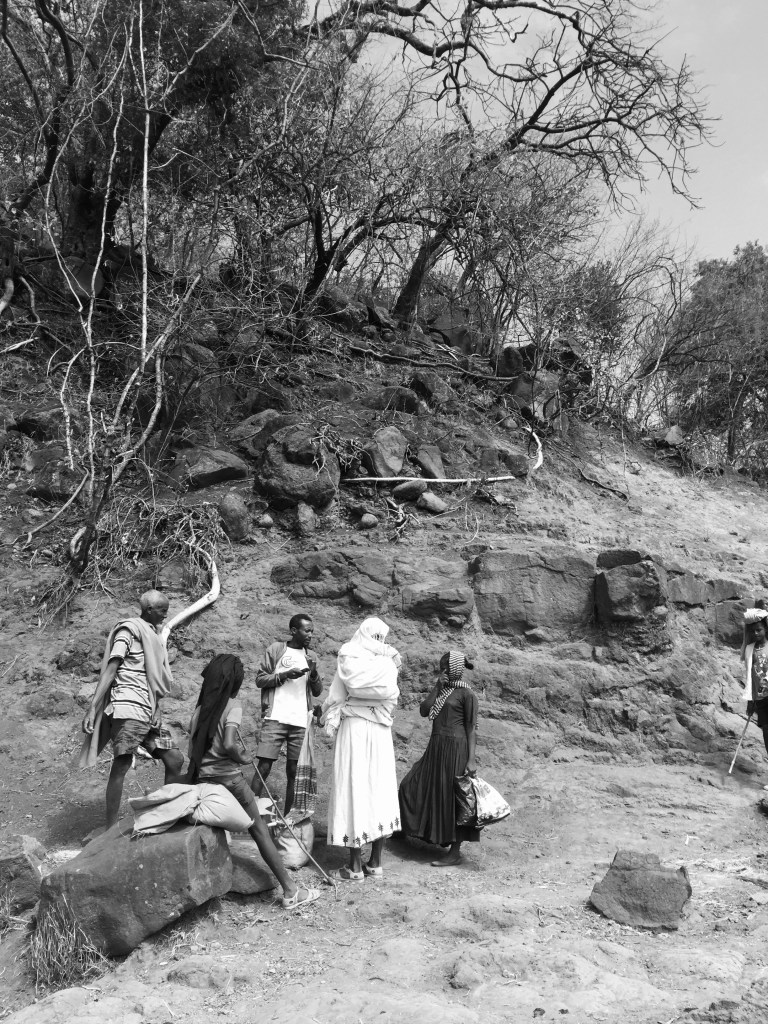
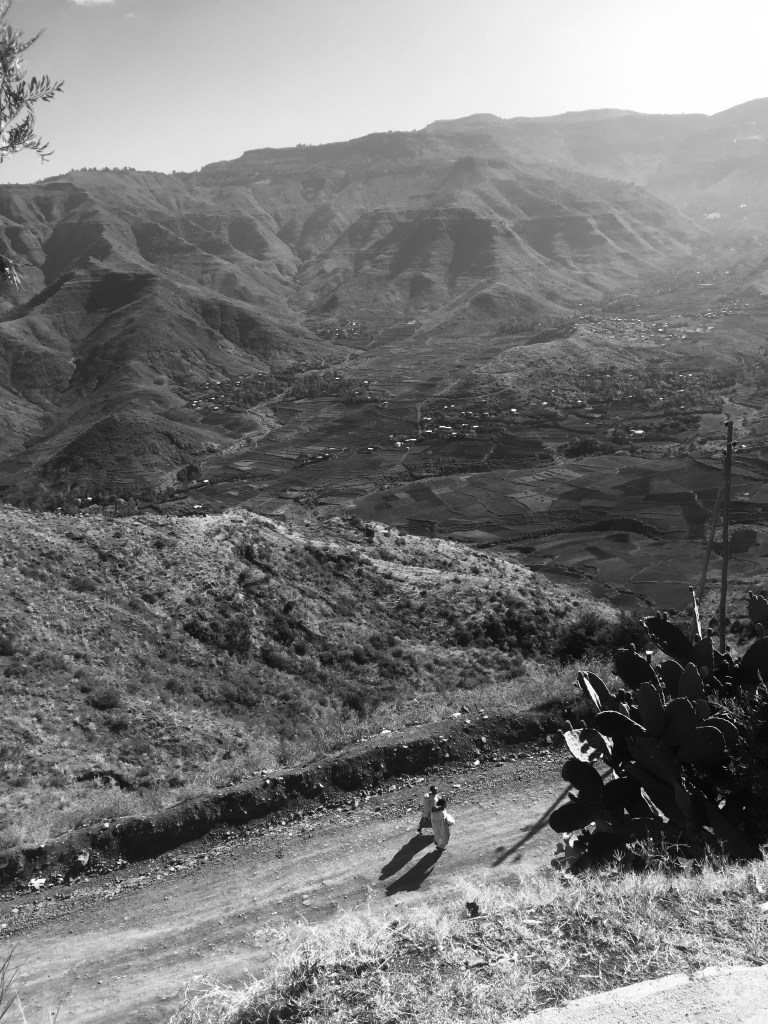
What followed over the next month after arriving in the capital, Addis Ababa, was an almost constant flow of movement across the north of the country, at a pace my provincial rhythms were simply unaccustomed to. Bahir Dar, Gondar, Axum, Mekele and The Simien Mountains sailed by in incessant exploration and numerous weekly flights. After many doses of the strongest coffee produced on record, tiny details, as usual, began to take hold of this kaleidoscopic voyage. A wonderful naivety shadowed my teenage figure as I searched the streets for the Ethiopia I’d imagined.
After attempting to contrive my own image of the country for the first few days, such as playing Girma Beyene’s Yebeqagnal to taxi drivers in a bid to gain cultural clout, it became apparent that no such contrivance was necessary. Everything was so visually and audibly novel that to stray even for a second from the present moment appeared superfluous. In a single day, traversing the mountains began with an armed guard carrying a rifle for baboon threats -where we bumped into two young boys herding cattle – before entering one of the many semi-inaccessible monolithic churches I would visit during my stay.
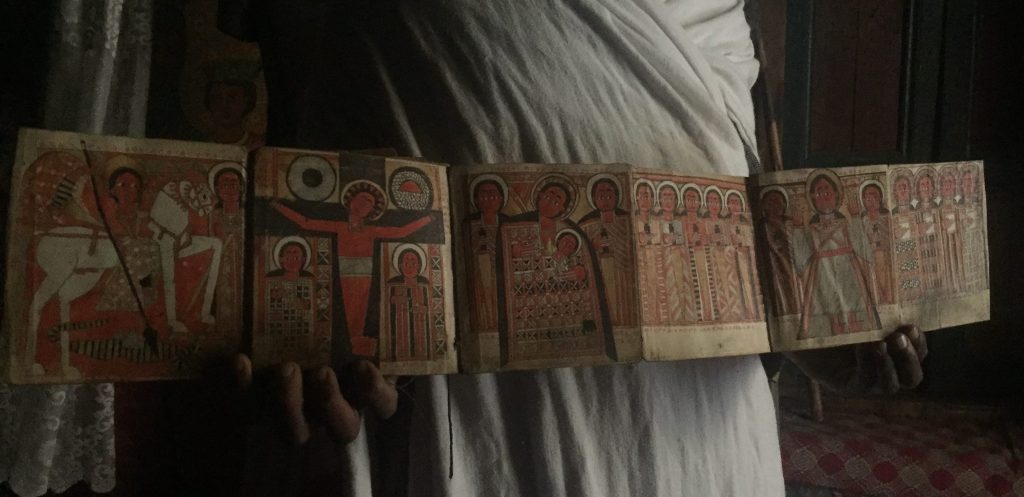
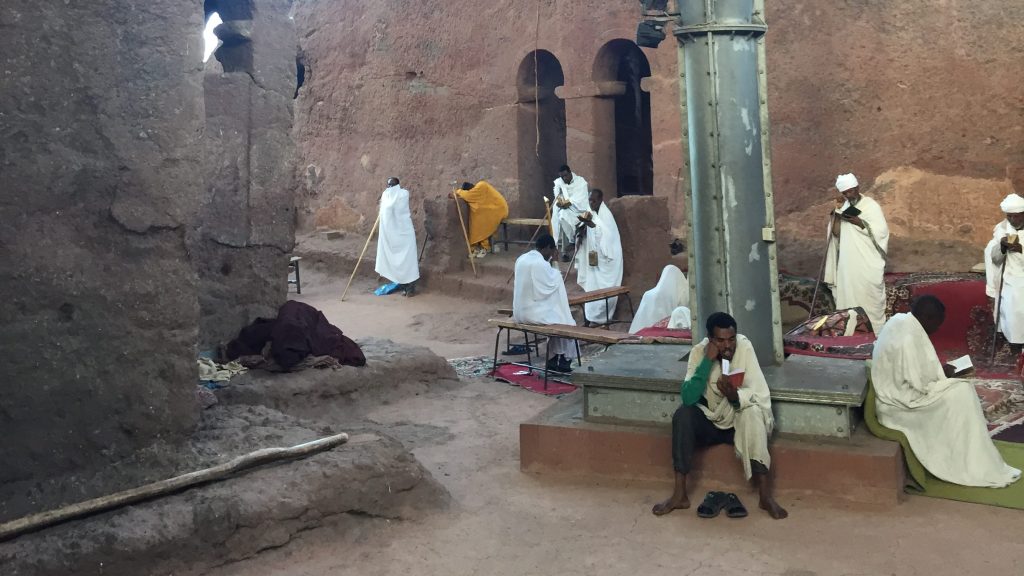
Sundays in Ethiopia are the ultimate Sundays. Nowhere is this more true than in Lalibela, a town in the Amhara region where the rock-hewn churches – built in the twelfth and thirteenth centuries, some of which are carved into cliff faces – still remain active places of worship for Christians. Starting at sunrise pilgrims flocked, all dressed in white robes and carrying umbrellas against the intensifying heat, to the almost inaccessible churches and began peacefully reading from worn prayer books. Art works scattered the walls and were lit up by candle light as people found spaces for introspection down alleyways, inside, against the side of and in the forecourt of the unique churches.
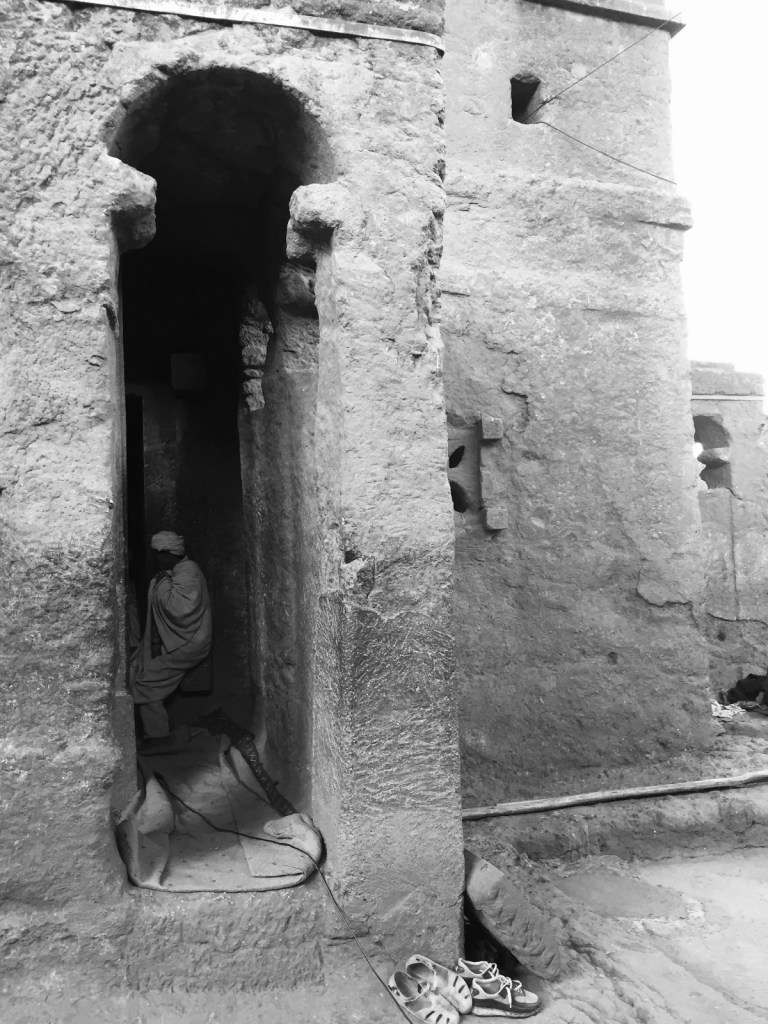
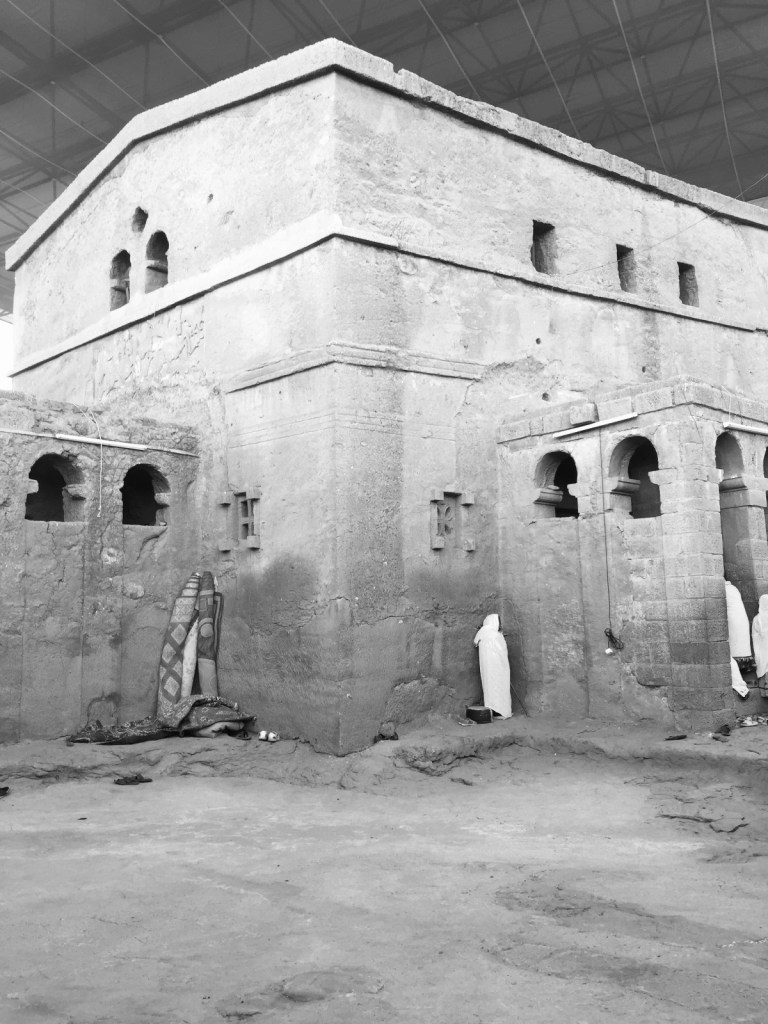
After circling around the north for three and a half weeks, the final four days took the journey as far north as is possible in Ethiopia, and to cap off what had already been a revelatory experience, it happened to be the most naturally extreme, the place that holds the record for the highest average year-round temperature of any inhabited place on Earth, with daily highs frequently exceeding 45 degrees celsius: namely, The Danakil Depression.
Right on the border with Eritrea, a place conflict had restricted all visitation not long before and ever since, there are phosphorus acid lakes, salt flats and and active volcanoes. Sleeping outside under the stars was complimented by four travel companions: a Hong Kong-born doctor living in New York; a Colombian flight attendant living in Qatar; a German who builds schools for refugees in Lebanon; and our local driver who calmly persisted through the impenetrable roads to each location.
At the Danakil, men had walked for seven days from the nearest town in the Afar region with camels to reach the flats where they would chop away for hours at the lucrative salt. They would load the salt in blocks onto the camels, then walk the same distance home. I had for so long dreamed of the idyllic scenes of athletes running at dusk under the orange moon and kicking up scores of dust in their wake. This could never have been imagined. The aforementioned doctor remarked that what we had seen over four days was special precisely because of its inaccessibility; it took us six hours to get from our overnight stay before arriving at the curvature of the salt flats. All the more respect to those gentlemen and camels traversing on foot.
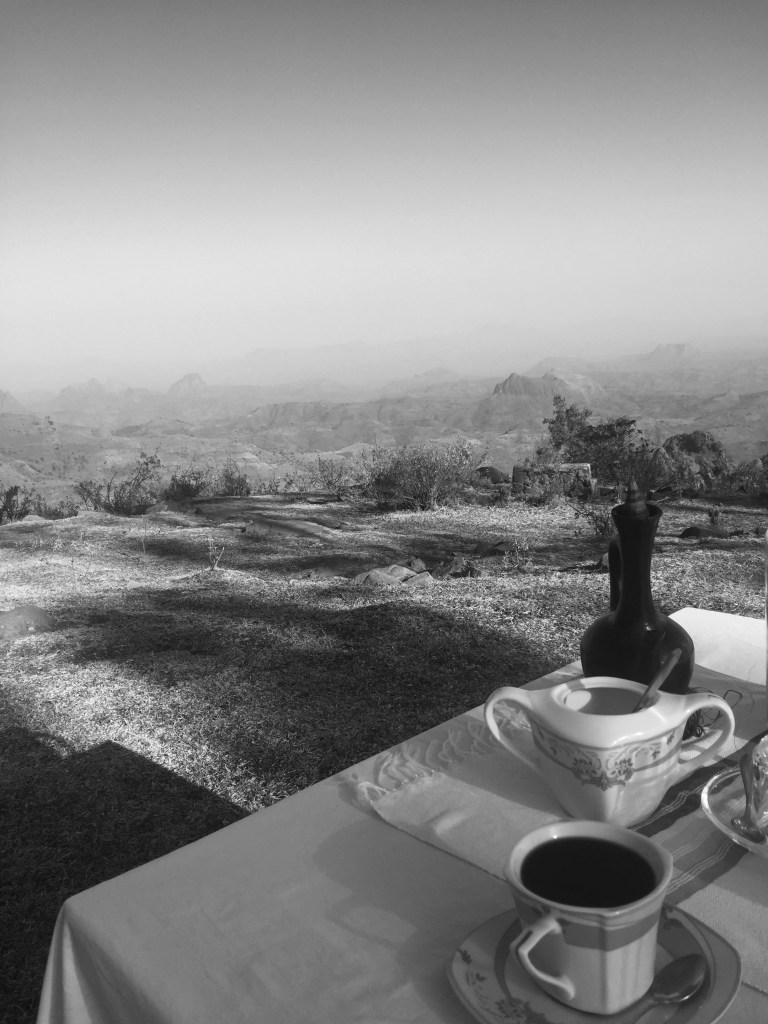
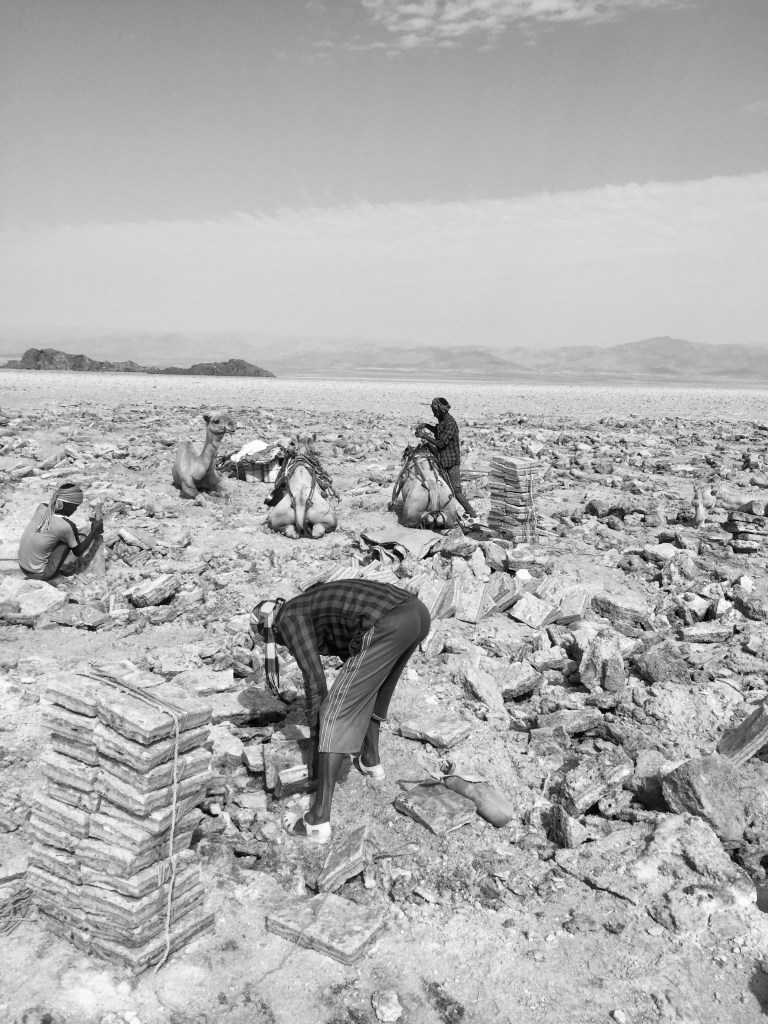
The romanticised version of life in Ethiopia was no more; reality transcended it. But it still acted as a launchpad to get me there. From the communal sense of stillness, coffee, altitude, the runners, geometry of carved churches, it was the Ethiopian relationship to ritual and the people’s monastic respect for daily details and connection to their land, all impressions that cannot be conjured from afar, that I connected with the most.
Ethiopia taught me what a month could be. Nervously trying to hide my camera out of courtesy but wanting to capture as much as possible. Trying to process one city to the next. The complete solitude. But, above all else, it was the introduction to realising that, in a place like Ethiopia, the least interesting thing is myself.
Words and photography by Jonny Mumby.


Leave a Reply